Business Processes & Service Design
Mapping, analysis and design of shared business processes and services across Red Cross Denmark's asylum centre operations - bringing coherence to a fragmented, siloed organisation ahead of a new case-management system.
Red Cross · Denmark
· No collaboration - departments operating for themselves. · No shared agenda across the organisation. · No common understanding of pain points. · No interdepartmental documentation or process standards.
· New, documented Business Processes adopted across departments. · Better working environment through shared ownership. · Coherent, unified workflow across previously siloed functions. · Transparency between departments. · A clear implementation strategy, ready to execute.
“Symmetric Sammetric did an amazing job at visualising our business processes and re-designing them together with us. It was a very enlightening experience to see the different viewpoints and agendas come together in boxes and flow. We now have a product that we can continue to improve and work on as one organisation.”
Helge Petersen, Project Manager
The client and what we did for them
Red Cross has run asylum centres in Denmark since 1984, under contract with the Danish state. The centres provide a wide range of services - kindergarten and school, activation and education, a health clinic, social support, and leisure activities. The asylum department alone runs more than 30 centres, alongside health and social tasks at departure centres.
As the organisation prepared to implement a new case and document management (ESDH) system, it became clear that its departments - Drawing room/internal service, Purchasing, Deposits, IT, Budget and Economy - were each running similar processes their own way, with little coordination between them.
Our Approach
The first task was mapping the “as-is” workflow across departments, focused on the relationships between technology, people, organisation and physical framework - surfacing where silos were slowing the organisation down, ahead of the ESDH rollout.
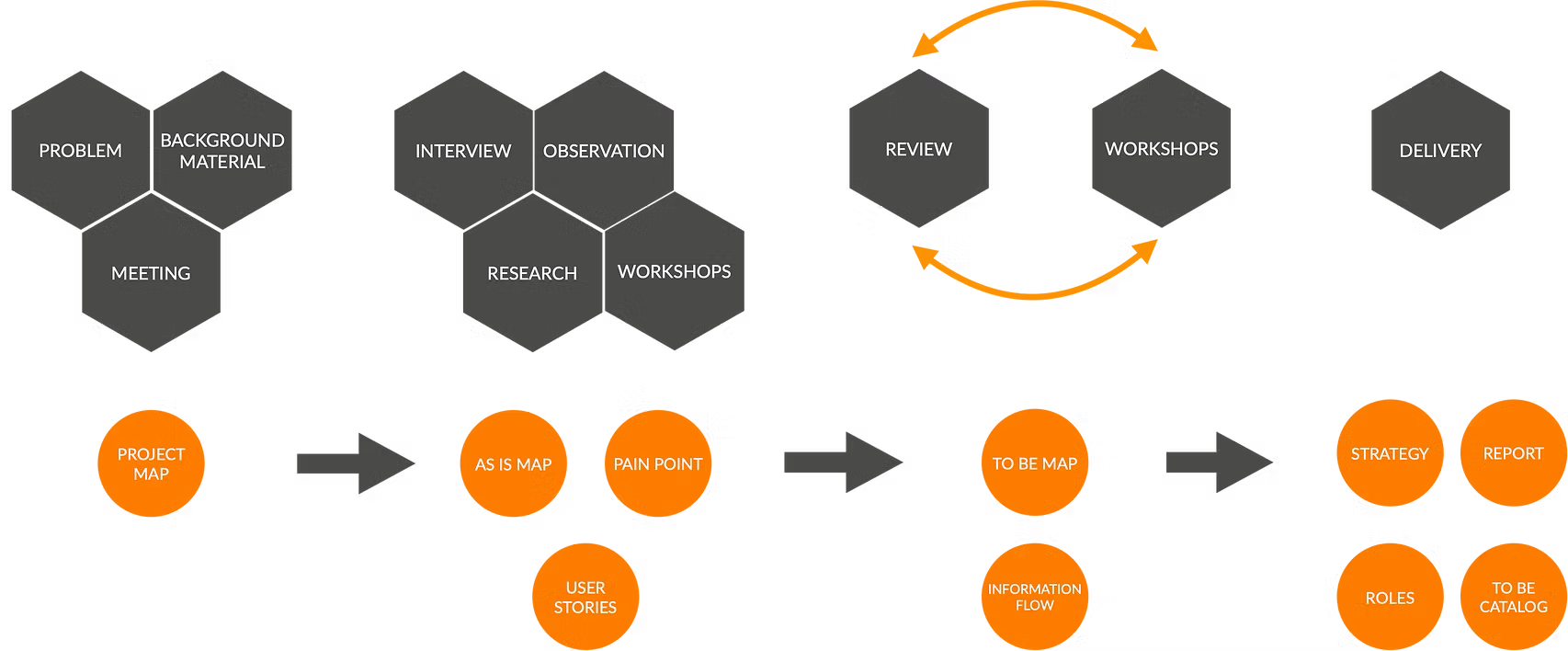
We used a workflow analysis and service design methodology, combining qualitative and quantitative research with design methods:
- Preparation and review of background material
- Interviews, meetings, observations and workshops across departments
- Documentation of business processes, department by department
- Identification of pain points and redundancies
- Design and mapping of desired future-state processes and information flow
- Analysis of risk, roles, politics and controls
- Documentation of future-state processes
- An implementation strategy, agreed through clarification meetings with stakeholders
Outcome
The engagement produced a common understanding of the organisation’s business processes, built on strong cross-departmental collaboration, and was handed over with clear recommendations and an implementation strategy.
Got a similar challenge?
Let's talk about what's possible for your organisation.